Disaster Management: Textbook for Civil Services Examination by Pavneet Singh | UPSC GS Paper-III | Top Teachers’ Series
₹145.00

100% Safe & Secure Payments

Easy return and replacements

Extra Discount & Free Delivery
Product Short Details
Product Short Details
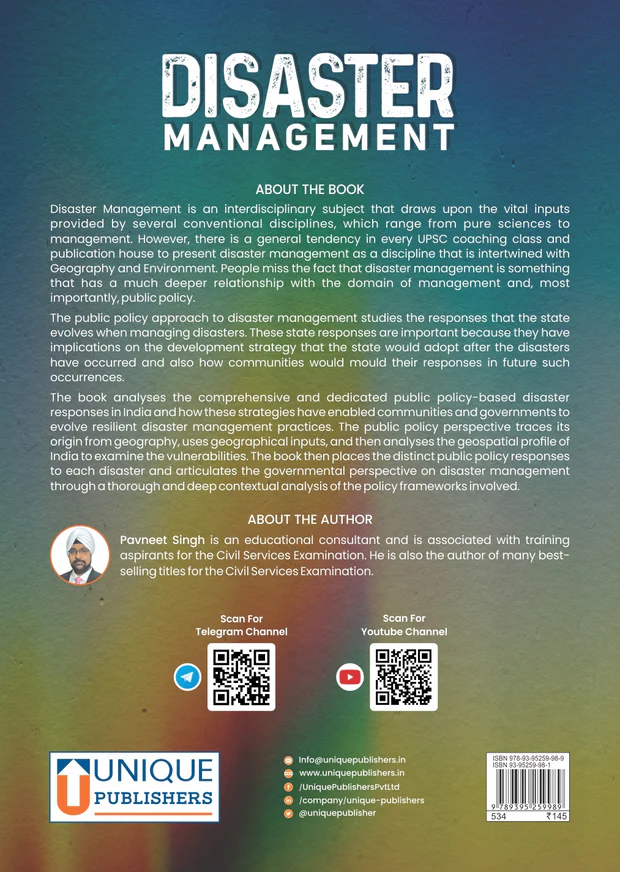
Every coaching class teaches Disaster Management as a branch of Geography. That is the mistake. Cyclones and earthquakes are geography. But UPSC is not asking you about the cyclone — it is asking you about the state’s response to it. And that is public policy.
- ✅ The public policy approach — how the state actually responds to disasters, which is what the exam tests
- ✅ India’s geospatial vulnerability profile — the geography, used as an input rather than the whole subject
- ✅ Policy frameworks analysed in depth, disaster by disaster
- ✅ How communities and governments build genuine resilience
- 📘 English | Pavneet Singh | Unique Publishers
🎉 FLAT 30% OFF — Apply coupon code TOPPERSKART at checkout.
Product Description
Product Description
Disaster Management: Textbook for Civil Services Examination — by Pavneet Singh
Walk into any UPSC coaching class and you will find Disaster Management filed neatly under Geography and Environment. Learn the types of cyclones. Memorise the seismic zones. Note the difference between a hazard and a disaster. Move on.
This book argues that the entire framing is wrong — and it has a point.
Disaster Management is genuinely interdisciplinary, drawing on everything from the pure sciences to management. But its deepest relationship is not with geography at all. It is with public policy. Because in the exam hall, UPSC is almost never asking you to describe a flood. It is asking what the state did about it, whether that response worked, and what should change before the next one.
An aspirant who has only studied the physical science of disasters has, at that moment, nothing useful to write.
The Public Policy Approach
The public policy lens studies something quite different from the disaster itself: the responses the state evolves in order to manage it. Those responses matter far beyond the immediate crisis, because they shape:
- The development strategy the state adopts in the aftermath — rebuilding is a policy choice, not an inevitability
- How communities respond to future events — resilience is learned, and it is learned from how the last disaster was handled
- Institutional capacity — every disaster either strengthens or exposes the machinery meant to handle the next one
That is the material a strong GS Paper-III answer is built from. Not the anatomy of a cyclone.
How the Book Is Structured
The approach is deliberately sequential, and it does not throw geography away — it puts it in its proper place:
- Origins in geography — the geographical inputs that determine what India is actually exposed to
- India’s geospatial vulnerability profile — mapping where the risks concentrate, and why
- Distinct policy responses to each disaster — floods, cyclones, earthquakes, droughts, industrial and biological disasters, each with its own governmental response
- Deep contextual analysis of the policy frameworks — not just what the framework says, but what problem it was built to solve
- The governmental perspective — how the state itself understands disaster management, which is the perspective UPSC expects you to write from
Why This Matters for Your Answers
Disaster Management sits in GS Paper-III, alongside internal security and environment. Questions there are evaluative: was the response adequate, what are the institutional gaps, how should the framework evolve. These demand a policy vocabulary and an administrator’s judgement.
An aspirant who has read this book can frame the vulnerability, assess the policy response, identify where it failed, and propose a reform — a complete answer arc. An aspirant who has only memorised disaster typologies can define the terms and then run out of things to say by the second paragraph.
Who Is This Book For?
- UPSC CSE Mains aspirants preparing Disaster Management in GS Paper-III
- Aspirants whose disaster answers stay descriptive — types, definitions, causes — and never reach analysis
- Public Administration and Geography optional students looking at disaster policy from the governance side
- State PSC candidates — UPPSC, BPSC, MPPSC, RAS and others
- Anyone who has been taught Disaster Management as a Geography sub-topic and sensed something was missing
About the Author
Pavneet Singh is an educational consultant associated with training aspirants for the Civil Services examination, and the author of several bestselling UPSC titles, including Indian Polity Mind Maps, My Notes from the 2nd ARC Reports, Fundamentals of Ethics, Indian Society, UPSC Lal Kitab and The Indian Economy.
Book Details
- Author: Pavneet Singh
- Series: Top Teachers’ Series
- Publisher: Unique Publishers
- Language: English
- ISBN: 978-93-95259-98-9
- Exam: UPSC CSE Mains — GS Paper-III (Disaster Management)
Why Order From ToppersKart?
- FLAT 30% OFF — use coupon code TOPPERSKART
- 100% original, publisher-sourced edition
- Cash on Delivery available, fast shipping across India
- Easy return & replacement
Frequently Asked Questions
Q. Is this enough for Disaster Management in GS Paper-III?
Yes, for the policy and governance dimension — which is what the paper actually tests. Keep supplementing with current disaster events and the government’s response to them through the year.
Q. I’ve already covered disasters in my Geography notes. Do I still need this?
Almost certainly. Geography tells you what a disaster is and where it strikes. This tells you what the state does about it, whether that worked, and what should change — which is the substance of a Mains answer.
Q. Does it skip the geography entirely?
No. It begins with the geographical inputs and India’s geospatial vulnerability profile, then builds the policy analysis on top. Geography is treated as a foundation, not as the whole subject.
Q. What else has Pavneet Singh written?
My Notes from the 2nd ARC Reports, Fundamentals of Ethics, Indian Society, Indian Polity Mind Maps and UPSC Lal Kitab — all in our Unique Publishers collection.
Related Products