Secret History of Selection of Supreme Court Judges by Pavneet Singh | Collegium System & NJAC Judgment Explained | UPSC & State PSC
₹185.00

100% Safe & Secure Payments

Easy return and replacements

Extra Discount & Free Delivery
Product Short Details
Product Short Details
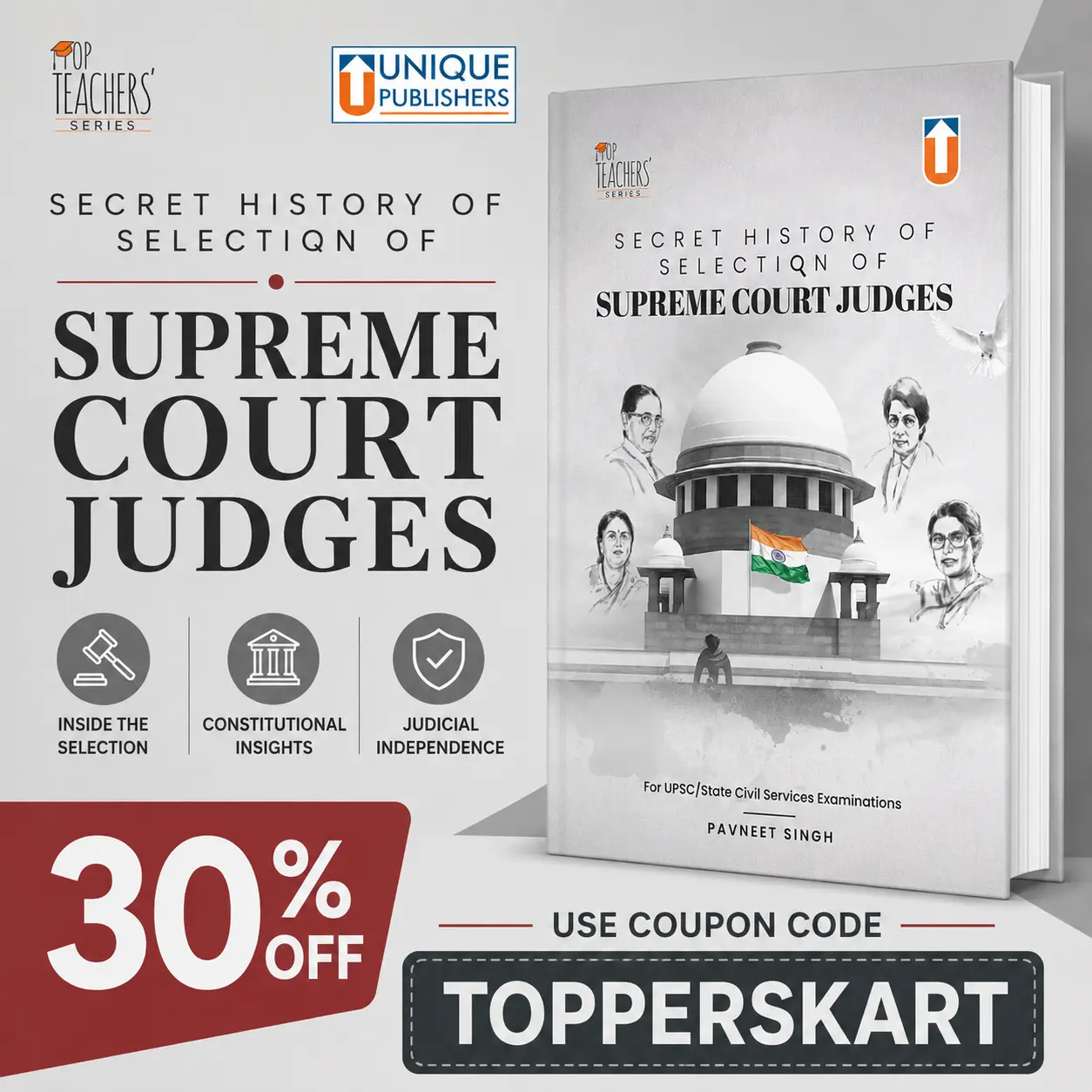
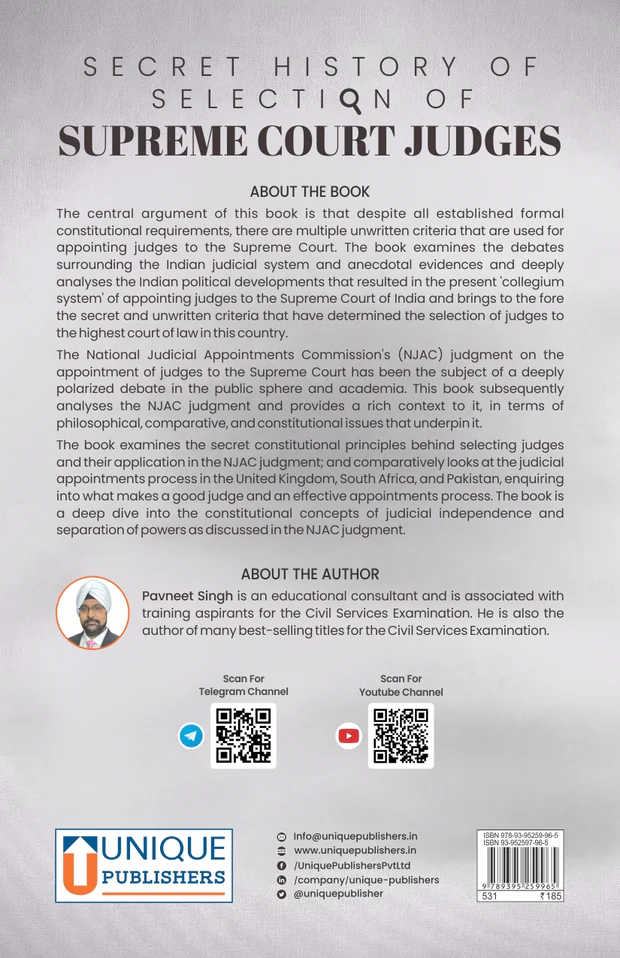
The Constitution tells you how Supreme Court judges are appointed. This book argues that is not how it actually happens. Beyond the formal requirements sit a set of unwritten criteria — never codified, never acknowledged, but consistently decisive. This is an account of what they are and how they came to be.
- ✅ How the collegium system actually emerged — the political developments that produced it
- ✅ The NJAC judgment, contextualised — philosophical, comparative and constitutional issues beneath the headlines
- ✅ International comparison — how the UK, South Africa and Pakistan appoint their judges
- ✅ A deep dive into judicial independence and separation of powers
- 📘 English | Pavneet Singh | Unique Publishers
🎉 FLAT 30% OFF — Apply coupon code TOPPERSKART at checkout.
Product Description
Product Description
Secret History of Selection of Supreme Court Judges — by Pavneet Singh
Ask an aspirant how Supreme Court judges are appointed and you will get a competent answer: Article 124, consultation with the Chief Justice, the collegium, the Second and Third Judges Cases. All correct. All from the textbook.
Now ask why a particular judge was elevated and another equally qualified one was not. The textbook has nothing to say.
That silence is what this book is about. Its central argument is that alongside the formal constitutional requirements, there exists a set of unwritten criteria — never codified, rarely admitted, and consistently decisive — that shape who reaches the highest court in the country.
What the Book Examines
- How the collegium system came to exist — traced through the Indian political developments that produced it, rather than presented as a settled fact
- The unwritten criteria that have determined judicial selection, drawn out through debate and anecdotal evidence
- The NJAC judgment — one of the most polarising constitutional decisions of recent decades, given the context it is usually stripped of
- Secret constitutional principles underlying judicial selection, and how they surfaced in the NJAC reasoning
- Judicial independence and separation of powers — examined as living constitutional problems, not glossary entries
The Comparative Lens
One of the book’s most useful sections steps outside India entirely. It examines how judges are appointed in the United Kingdom, South Africa and Pakistan, and asks a question Indian debate rarely pauses on: what actually makes a good judge, and what makes an effective appointments process?
That comparison is where the book earns its value for an examinee. It is one thing to describe the collegium. It is another to place it beside three alternatives and argue, with evidence, about what it does well and where it fails. The second is what Mains rewards.
Why This Matters for UPSC
Judicial appointments sit at the intersection of several high-frequency areas: the judiciary in GS Paper-II, separation of powers, constitutional morality, checks and balances, and the perennial question of judicial accountability versus judicial independence.
The collegium-versus-NJAC debate is exactly the kind of contested constitutional question UPSC likes — because it has no comfortable answer, and it rewards a candidate who can hold both sides honestly. Most aspirants can define the collegium. Very few can write a balanced, informed paragraph on why it is defended and why it is attacked. This book is how you become one of them.
It is equally useful for Essay, where questions on democracy, institutions and accountability recur, and for the Interview, where an informed view on a live constitutional debate stands out sharply.
A Note on Balance
The collegium and the NJAC remain genuinely contested. The debate is polarised in both public discourse and academia, and reasonable people disagree about it. This book puts forward a clear argument, and it is worth reading as an argument — engage with it, test it, and form your own position. For UPSC, that is precisely the right way to use it. The examiner is not looking for your side. They are looking for evidence that you understand both.
Who Is This Book For?
- UPSC CSE Mains aspirants preparing the judiciary and constitutional governance in GS Paper-II
- Aspirants whose polity answers stay descriptive and never reach the constitutional debate underneath
- Essay and Interview candidates who want a genuine, defensible view on judicial independence
- Law and Public Administration optional students
- State PSC candidates — UPPSC, BPSC, MPPSC, RAS and others
- Anyone interested in how Indian constitutional institutions actually work, as opposed to how they are described
About the Author
Pavneet Singh is an educational consultant associated with training aspirants for the Civil Services examination, and the author of several bestselling UPSC titles, including Indian Polity Mind Maps, My Notes from the 2nd ARC Reports, Disaster Management, Fundamentals of Ethics, Indian Society and UPSC Lal Kitab.
Book Details
- Author: Pavneet Singh
- Series: Top Teachers’ Series
- Publisher: Unique Publishers
- Language: English
- ISBN: 978-93-95259-96-5
- Exam: UPSC CSE & State Civil Services — GS Paper-II (Polity & Governance)
Why Order From ToppersKart?
- FLAT 30% OFF — use coupon code TOPPERSKART
- 100% original, publisher-sourced edition
- Cash on Delivery available, fast shipping across India
- Easy return & replacement
Frequently Asked Questions
Q. Is this a syllabus book?
Not in the usual sense. It is a focused deep dive into judicial appointments — the collegium, the NJAC and the constitutional principles beneath them. It gives you depth on a topic your standard Polity book covers in a page.
Q. Do I need to have read a Polity textbook first?
It helps. Get the basics of Articles 124 and 217 and the Judges Cases from a standard source, then read this for the debate, the context and the comparative perspective.
Q. Is the book one-sided on the collegium debate?
It advances a clear argument, as any good book on a contested question does. Read it as an argument, weigh it against the counter-position, and form your own view — which is exactly what UPSC expects of you anyway.
Q. What else has Pavneet Singh written?
Indian Polity Mind Maps, My Notes from the 2nd ARC Reports, Disaster Management, Fundamentals of Ethics and Indian Society — all in our Unique Publishers collection.
Related Products