Art & Culture Mind Maps by Pavneet Singh | UPSC Quick Revision
₹585.00

100% Safe & Secure Payments

Easy return and replacements

Extra Discount & Free Delivery
Product Short Details
Product Short Details
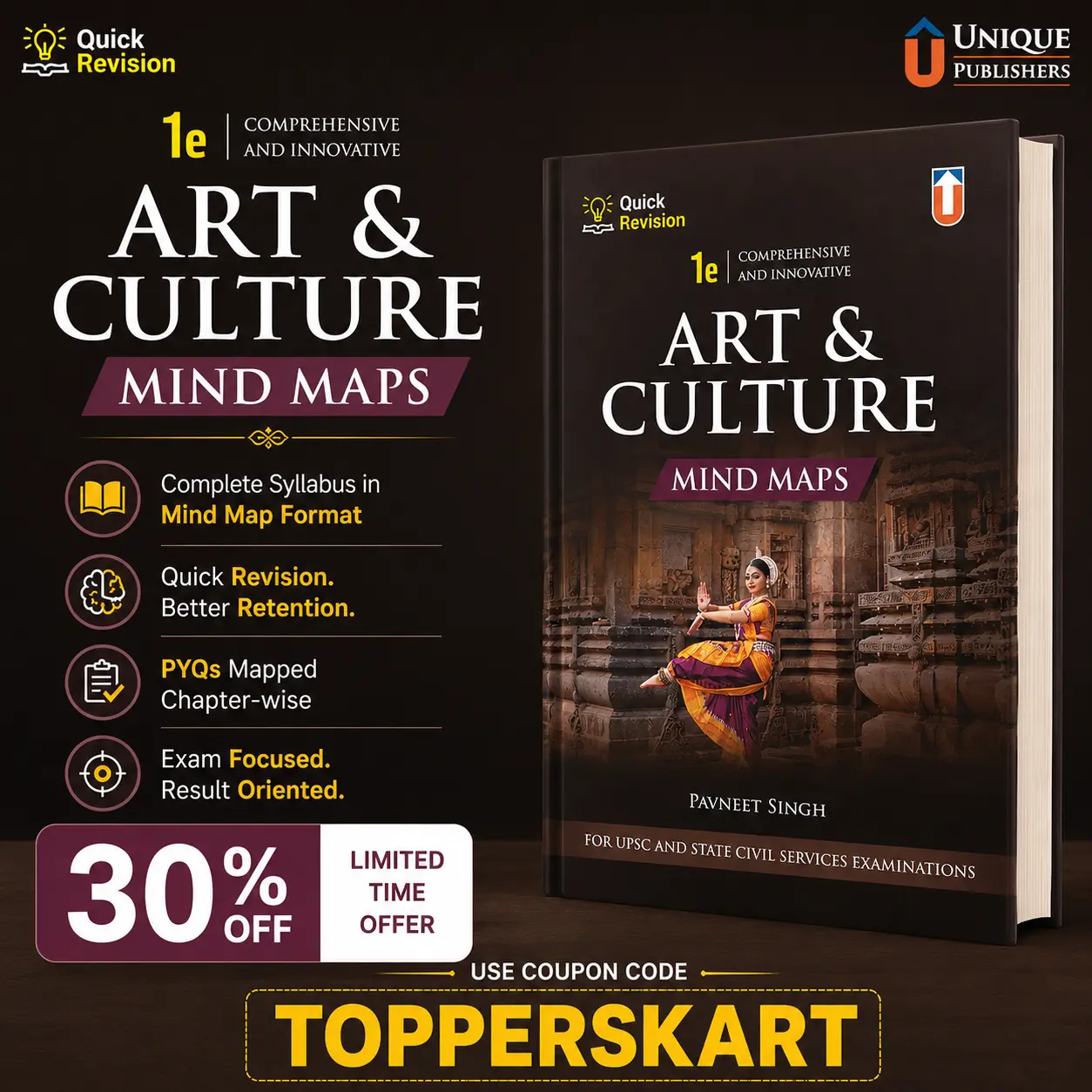
Art & Culture is the section aspirants dread most — and for good reason. Dance forms, temple architecture, painting schools, music gharanas, festivals, philosophies. Pure fact, almost no logic, and forgotten within a fortnight of reading. This book is built for exactly that problem.
- ✅ Complete Art & Culture syllabus in flow charts — structure where there was only a list
- ✅ Mapped PYQs at the end of every chapter — see exactly what UPSC has actually asked
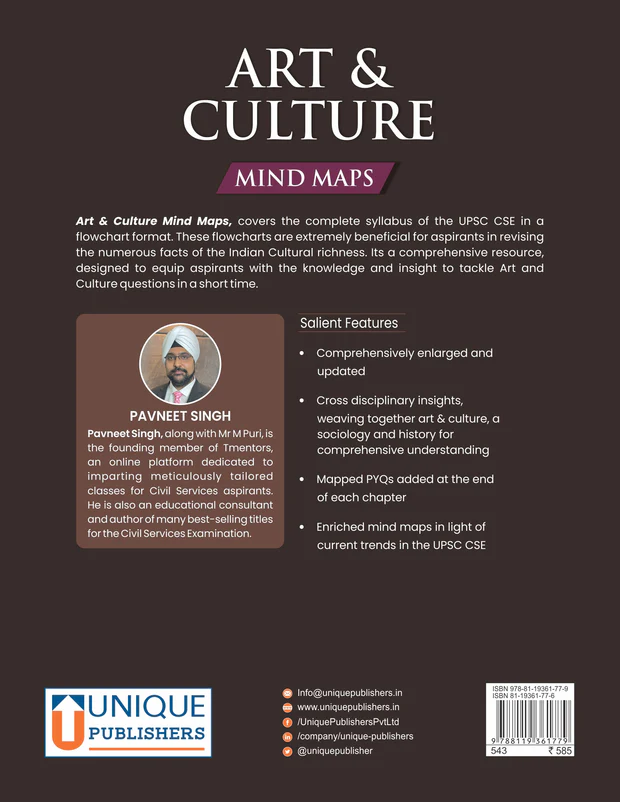
- ✅ Cross-disciplinary insights — art, culture, sociology and history woven together, not siloed
- ✅ Enriched mind maps aligned with current UPSC trends
- 📘 English | Pavneet Singh | Unique Publishers
🎉 FLAT 30% OFF — Apply coupon code TOPPERSKART at checkout.
Product Description
Product Description
Art & Culture Mind Maps — by Pavneet Singh
Every aspirant has the same experience with Art & Culture. You read a chapter on classical dance forms. You understand all of it. Two weeks later you cannot reliably tell Kuchipudi from Kathakali, and you have no idea why.
The reason is structural. Art & Culture is almost pure fact — hundreds of names, forms, dynasties, styles and periods, with very little internal logic to hang them on. Prose is the worst possible medium for that kind of material. You do not need to read Art & Culture again. You need to see it.
That is what this book does. Every topic is restructured into a flow chart, so the relationships that were buried in paragraphs become visible at a glance — and, crucially, memorable.
What Makes This One Different
- Mapped PYQs at the end of each chapter — the single most useful feature. You revise a topic, then immediately see precisely how UPSC has framed questions on it. No guessing what matters
- Cross-disciplinary insights — art and culture are deliberately woven together with sociology and history, because that is how UPSC actually asks about them. A temple is not just architecture; it is economy, patronage and society too
- Enriched maps built around current trends — updated in light of how the examination has evolved, not how it looked a decade ago
- Comprehensively enlarged and updated — this is a first edition built on current syllabus reality
Why Flow Charts Work for This Subject Specifically
Art & Culture rewards recall, not reasoning. In the exam hall you are not being asked to argue — you are being asked whether you can place Bharatanatyam in Tamil Nadu, distinguish Nagara from Dravida, or recall which Sultanate commissioned which structure. That is retrieval under time pressure.
Visual layouts are retrieved faster and more reliably than text. A mind map lets you take in an entire topic in one visual sweep, and hold it. Over five revisions, that difference compounds into marks.
What’s Covered
- Indian architecture — temple styles, rock-cut caves, Indo-Islamic, colonial and modern
- Sculpture, painting schools and their regional lineages
- Classical and folk dance forms, mapped to region and tradition
- Indian music — Hindustani, Carnatic, gharanas and instruments
- Religion, philosophy and schools of thought
- Literature, languages, theatre, festivals and UNESCO heritage sites
Who Is This Book For?
- UPSC CSE Prelims aspirants — Art & Culture is a reliable scoring area if you can retain it, and this is what makes retention possible
- Mains candidates preparing GS Paper I, where cultural questions demand connected understanding rather than isolated facts
- State PSC candidates — UPPSC, BPSC, MPPSC, RAS and others
- Repeaters who have read the standard textbook more than once and still forget it
- Visual learners for whom paragraphs of factual prose simply do not stick
How to Use It
Read a standard Art & Culture source once for context and understanding. Then switch to Mind Maps for every revision thereafter. Work through the mapped PYQs at each chapter’s end as you go — they will tell you, faster than any strategy video, which parts of a topic UPSC actually cares about.
About the Author
Pavneet Singh, along with M. Puri, is a founding member of TMentors — an online platform offering carefully tailored classes for Civil Services aspirants. He is an educational consultant and the author of several bestselling UPSC titles, including Indian Polity Mind Maps, Passport to LBSNAA, Ethics, Integrity & Aptitude, Indian Economy and UPSC Lal Kitab.
Book Details
- Author: Pavneet Singh
- Publisher: Unique Publishers
- Edition: 1st Edition
- Language: English
- ISBN: 978-81-19361-77-9
- Exam: UPSC CSE & State Civil Services Examinations
Why Order From ToppersKart?
- FLAT 30% OFF — use coupon code TOPPERSKART
- 100% original, publisher-sourced edition
- Cash on Delivery available, fast shipping across India
- Easy return & replacement
Frequently Asked Questions
Q. Can this be my only Art & Culture book?
It is designed as a revision resource, so most aspirants pair it with one standard textbook read once for context. After that, this becomes your working book for every revision cycle.
Q. What are “mapped PYQs”?
Previous year questions placed at the end of each chapter, tied directly to the topic you have just revised — so you immediately see how UPSC has framed questions on that specific area.
Q. Is it useful for Mains as well?
Yes. It is built primarily for Prelims recall, but the cross-disciplinary structure also supports GS Paper I answers, where cultural questions expect connected understanding.
Q. Are there other Mind Maps books?
Yes — Indian Polity Mind Maps, Science & Technology Mind Maps and Environment Mind Maps. Browse our Unique Publishers collection.